



Upstream & Downstream Processing
(USP & DSP) in Biopharmaceutical Manufacturing
A referenced guide to how biologics are made – from cell culture to final drug product – and the media, buffers and Water for Injection (WFI) used at each step.
Biopharmaceutical manufacturing turns living cells into therapeutic products – monoclonal antibodies, recombinant proteins, viral vaccines, viral vectors, cell and gene therapies (ATMPs), and mRNA. It is divided into two connected stages: upstream processing (USP) – cell growth and product expression – and downstream processing (DSP) – recovery, purification and formulation. PAN-Biotech, an independent German manufacturer with 38 years’ experience, supplies the cell culture media, sera, serum-free media, reagents, buffers and pharmaceutical-grade water used across both stages, in research-use (RUO) and GMP (EU Annex 1) grades.
How to read the USP / DSP diagram
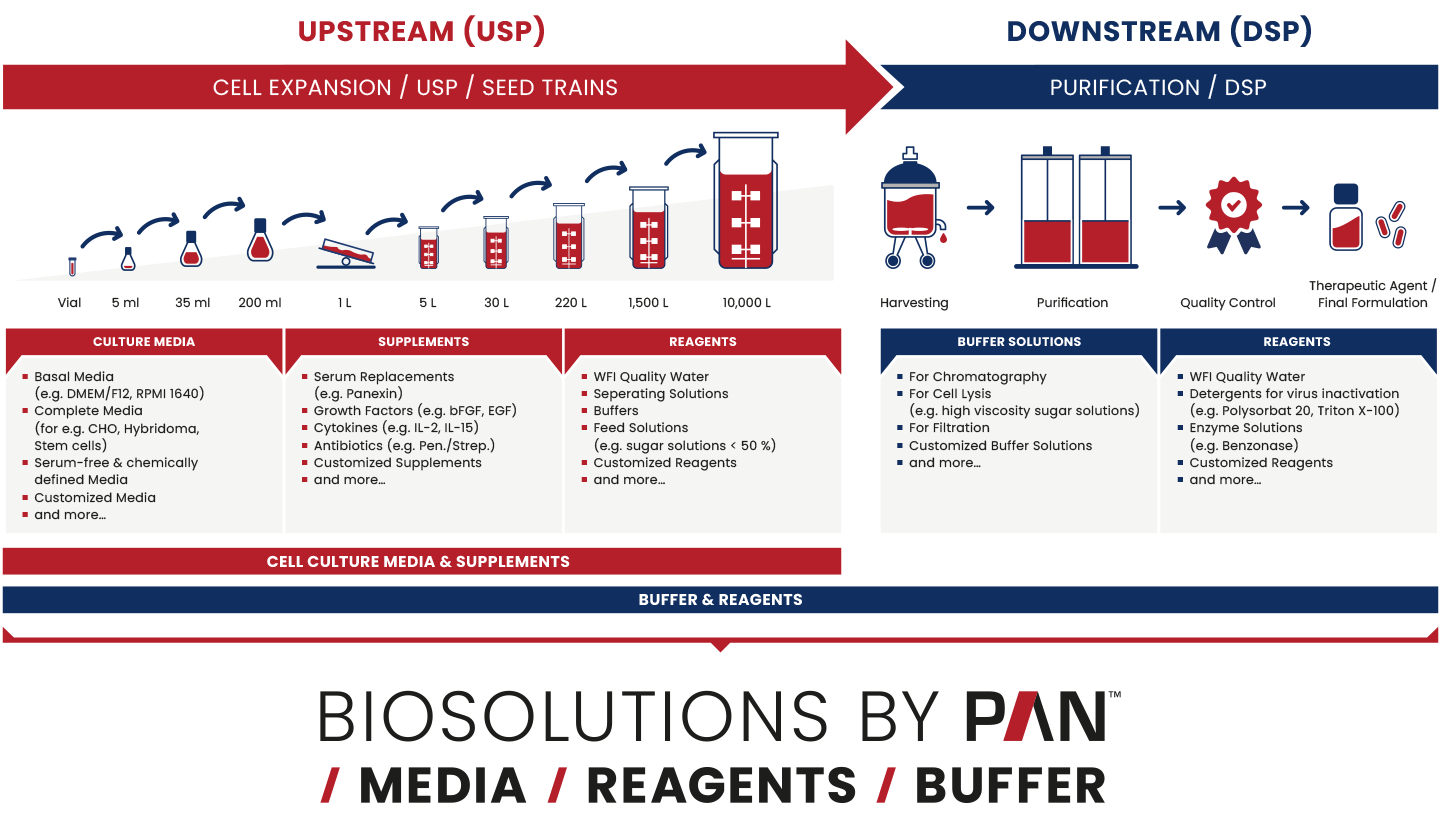
The diagram follows a process from left to right: the upstream section traces the scale-up path – from a small vial through progressively larger seed-train vessels into the production bioreactor – while the downstream section follows what happens after harvest: clarification, purification, quality control, and final formulation. It shows what is consumed where – in upstream, culture media, supplements and reagents; in downstream, buffers and reagents.
The scale-up axis runs to a typical large-scale process volume for orientation only; the volumes a given product reaches depend on its modality and titre. The highlighted band marks the range PAN-Biotech covers directly with materials and GMP manufacturing — from a 1-litre research batch to 1,000-litre GMP production, across two facilities with a combined capacity of ~1.8 million litres per year.
What is upstream processing (USP)?
Upstream processing (USP) is the foundation of biopharmaceutical production, spanning cell-line expansion through to large-scale cultivation in bioreactors. It begins with a qualified cell line from a Master Cell Bank (MCB) or Working Cell Bank (WCB). Through a controlled series of expansion steps – the seed train – cells are grown into progressively larger volumes until they reach production density. This applies whether the host is a mammalian line (CHO, HEK293), an insect (Sf9) or microbial system, or the primary immune, stem and MSC cells used in cell and gene therapy.
Throughout cultivation, critical process parameters – temperature, pH, dissolved oxygen, nutrients, osmolality, cell density and viability — are continuously controlled. Optimal growth depends on specialised cell culture media (basal media such as DMEM, RPMI 1640 and Ham’s F-12; serum-free and chemically defined media), feeds, supplements, growth factors and process reagents; their composition and quality directly influence cell performance, product yield, critical quality attributes (CQAs) and process robustness.
What is downstream processing (DSP)?
Downstream processing (DSP) comprises all operations needed to isolate, purify, concentrate and formulate the target molecule from a complex matrix of cells, cell debris, host-cell proteins, nucleic acids and impurities. The exact train is tailored to the modality; the logic is shared.
Harvest and recovery
Cells and particulates are removed from the culture broth, commonly by centrifugation followed by depth filtration or other clarification technologies.
Purification
A sequence of orthogonal unit operations removes impurities while preserving the molecule. Platform approaches are well established for monoclonal antibodies, Protein A affinity capture is followed by ion-exchange (IEX), hydrophobic-interaction (HIC) and size-exclusion (SEC) chromatography and ultrafiltration/diafiltration (UF/DF); for viral vaccines and viral vectors, clarification, nuclease treatment, chromatography and tangential-flow filtration (TFF); and for mRNA, in-vitro transcription (IVT) followed by purification and lipid-nanoparticle (LNP) encapsulation. Each step draws on defined buffers and process reagents — equilibration, wash and elution buffers, salts (NaCl, Tris, sodium acetate, citrate) and Water for Injection (WFI).
Viral safety
Dedicated viral inactivation and viral filtration steps are integral to the purification of cell-line-derived products, in line with ICH Q5A viral-safety expectations.
Quality control
Analytical testing throughout verifies identity, purity, potency, concentration, aggregate content, residual impurities and microbiological safety — the basis for product release.
Formulation and fill-finish
The purified active ingredient is formulated with buffers and excipients for long-term stability, then aseptically filled into vials, tubes, bottles, syringes, cartridges or 2D/3D single-use bags as the final drug product.
Why the quality of bioprocess materials matters
Biopharmaceutical manufacturing is a single, integrated chain: upstream conditions affect purification, and downstream parameters affect stability and efficacy. The quality and consistency of bioprocess raw materials – media, supplements, buffers, reagents and water – therefore have an outsized effect on yield, product quality, batch-to-batch consistency, scalability and GMP compliance. The economic weight sits downstream: downstream processing accounts for well over half of total biopharmaceutical production cost. These materials are not commodities but critical process inputs that deserve the same rigour as the equipment and the cell line itself.
Which PAN-Biotech products for each USP / DSP step?
(by application)
Whatever your modality, you can move from any process step to concrete PAN-Biotech product recommendations and a step-by-step product guide for your application:
- Antibody production – CHO, hybridoma, insect and HEK293 media, plus USP/DSP reagents and buffers (Protein A, IEX/HIC/SEC, UF/DF).
Explore antibody production - Vaccine production – Vero, MDCK, BHK21 and Sf9 media, plus downstream reagents and buffers.
Explore vaccine production - mRNA technology – HEK293 media plus nuclease-free water, buffers and process reagents.
Explore mRNA technology - Cell & gene therapy (ATMPs) – immune-cell, stem-cell and MSC media, plus separation, cryopreservation and buffer solutions.
Explore cell & gene therapy
Within each application, products are mapped to the individual USP and DSP steps – a basal medium, a feed, a capture or polishing buffer, a cryopreservation solution – matched to the exact point in your process. Downstream, these step-by-step buffers and reagents are also available as ready Process Kits by PAN-Celltech (Antibody available now; further modalities in progress).
The same product, in RUO and GMP – off one shelf
Most suppliers make you choose: a research catalogue or a GMP contract manufacturer. PAN-Biotech offers many of the same formulations in matched RUO and GMP grades, off the shelf – so you qualify a product once and carry it from research to GMP without changing supplier, formulation or documentation lineage. The research grade carries a P- catalogue number; the identical GMP grade carries a CT- number.
- DPBS – wash, dilution and formulation buffer (USP & DSP). Available RUO and GMP (CT-36500).
- DMEM and RPMI 1640 – classic basal media (USP). Available in matched RUO and GMP grades.
- HybridBoost – defined serum-free hybridoma medium (USP). Available RUO and GMP.
- Also in GMP grade: MEM, Medium 199, HEPES, L-Glutamine, Trypsin/EDTA and Penicillin-Streptomycin, Accutase, and Panexin CD / Panexin basic (the world’s first serum replacemtn, in GMP).
- Cryopan / Cryopan DMSO-free (cryopreservation) and Powerstem MSC (MSC / stem-cell media) – catalogue products, with GMP available as customised production.
The regulatory keystone — GMP DPBS with a filed DMF. GMP DPBS (CT-36500) is backed by a filed FDA Type IV Drug Master File. You can reference PAN-Celltech’s confidential manufacturing and quality data directly in your own submission through a letter of authorisation – without obtaining, holding or recreating it. For a buffer used across both USP and DSP, that removes one of the heaviest items a lean QA function would otherwise build from scratch.
The continuity is the differentiator: few suppliers offer the identical formulation in both research and GMP grades from a single manufacturer – with a filed FDA DMF on the most-used buffer. Browse the GMP-grade catalogue at shop.pan-biotech.de/en/GMP-grade, or request a Custom & GMP Project Enquiry for GMP and customised production.
Every PAN-Biotech product is available in GMP quality on request.
The table shows what is on the GMP shelf today (a P- number for RUO, a CT- number for GMP);
anything not yet on the GMP shelf is produced to GMP as customised production by PAN-Celltech.
RUO products carry a P- catalogue number; the identical GMP grade carries a CT- number. “On request” = produced to GMP as customised production.
Looking for a specific product – or the PAN-Biotech equivalent of a competitor’s?
Try Smart Product Search at pan-biotech.com/smart-product-search/ – it finds the right PAN-Biotech product, including equivalents to competitor product names.
One partner from research to GMP
PAN-Biotech & PAN-Celltech
PAN-Biotech provides the materials that recur at every stage – upstream culture media, sera, serum-free media, supplements and feeds, and downstream buffers and process reagents, including Water for Injection (WFI-quality water), with the premium WFI Beyond standard for the most demanding applications – and offers each in the grade your stage requires, from research use (RUO) through to GMP (EU Annex 1). The GMP and clinical-grade supply is manufactured by PAN-Celltech, PAN-Biotech’s dedicated GMP arm, in an EU Annex 1 facility backed by filed FDA Drug Master Files – so the same partner takes you from research materials to commercial manufacturing without changing supplier.
An independent German manufacturer for nearly four decades, PAN-Biotech serves 2,700 customers in 87 countries, produces across two facilities with ~1.8 million litres/year of capacity, and was named Top Contract Manufacturing Organization in Europe 2024 by Pharma Tech Outlook. With serum-free and chemically defined systems, customised formulations on request, and manufacturing scalable from a 1-litre batch to 1,000-litre GMP production, PAN-Biotech is one consistent, traceable materials partner from cell culture to final drug product – Made in Germany.
Have a specific USP/DSP requirement, or need GMP-grade materials?
Frequently asked questions
What is the difference between upstream and downstream processing (USP vs DSP)?
Your Subtitle Goes Here
Upstream processing (USP) is cell growth and product expression — cell-line expansion, the seed train, and cultivation in bioreactors, using culture media, feeds and supplements. Downstream processing (DSP) is recovery and purification — harvest and clarification, chromatography (Protein A, IEX, HIC, SEC), viral safety, UF/DF, and formulation and fill-finish, using buffers and process reagents.
What materials are used in downstream processing?
Your Subtitle Goes Here
Buffers and process reagents: equilibration, wash and elution buffers; salts such as NaCl, Tris, sodium acetate and citrate; stabilisers such as sucrose and trehalose; and Water for Injection (WFI). Downstream can account for well over half of total production cost, so buffer quality and supply reliability matter.
Do I need RUO or GMP-grade materials?
Your Subtitle Goes Here
Research-use-only (RUO) materials suit research and early development; GMP-ready and GMP (EU Annex 1) grades are used as you move toward clinical and commercial supply. PAN-Biotech supplies the same formulations in matched RUO, GMP-ready and GMP grades, so you qualify once and scale without changing supplier.
Does PAN-Biotech supply GMP-grade buffers and Water for Injection?
Your Subtitle Goes Here
Yes. GMP-grade buffers, reagents and WFI-quality water — and the premium WFI Beyond standard — are manufactured by PAN-Celltech, PAN-Biotech’s GMP arm, in an EU Annex 1 facility, backed by filed FDA Drug Master Files (DMFs).
Does PAN-Biotech offer a GMP version of every product?
Your Subtitle Goes Here
Yes. Every PAN-Biotech product is available in GMP quality on request. A range of 21 products is already on the GMP shelf — including DMEM, RPMI 1640, MEM Eagle, Medium 199, CMRL-1066, DPBS, HEPES, L-Glutamine, Trypsin/EDTA, Penicillin-Streptomycin, Accutase, HybridBoost, ISF-1, and Panexin CD and Panexin basic (the world’s first serum replacement, in GMP) — with PowerStem MSC1, Cryopan II and Cryopan III coming soon. Any other catalogue formulation is produced to GMP as customised production by PAN-Celltech, the group’s GMP arm (EU Annex 1).
Can I get the same medium or buffer in both RUO and GMP grades?
Your Subtitle Goes Here
Yes — that is the point of the matched-grade range. The research grade carries a P- catalogue number and the identical GMP grade a CT- number, so you qualify a product once and scale from research to GMP without changing supplier, formulation or documentation lineage.
What is the difference between P- and CT- catalogue numbers?
Your Subtitle Goes Here
P- denotes a research-use (RUO) catalogue product; CT- denotes the GMP grade of the same formulation. For example, DPBS is P04-36500 (RUO) and CT-36500 (GMP).
Does PAN-Biotech have a Drug Master File (DMF) for DPBS?
Your Subtitle Goes Here
Yes. GMP DPBS (CT-36500) is backed by a filed FDA Type IV Drug Master File. You can reference PAN-Celltech’s confidential manufacturing and quality data in your own submission through a letter of authorisation, without recreating it.
What is WFI Beyond?
Your Subtitle Goes Here
WFI Beyond is PAN-Biotech’s premium Water-for-Injection standard — beyond compendial on the attributes that matter (endotoxin, nuclease-free, TSE/BSE-free). Standard WFI-quality water is also available for routine use.
Can PAN-Biotech manufacture a custom GMP product to my specification?
Your Subtitle Goes Here
Yes. PAN-Celltech (EU Annex 1) develops and manufactures custom media, buffers and reagents to your specification, from small batches up to 1,000 L, with the full documentation package. Start a Custom & GMP Project Enquiry at pan-biotech.com/custom-gmp-project-enquiry/.
How do I find the PAN-Biotech equivalent of a competitor’s product?
Your Subtitle Goes Here
Use Smart Product Search at pan-biotech.com/smart-product-search/ — enter a competitor’s product name and it returns the matching PAN-Biotech product.
Which cell-culture media does PAN-Biotech offer for HEK293, CHO, Hybridoma, Vero, MDCK or Sf9 cells?
Your Subtitle Goes Here
Named media for each: Panserin 293 (HEK293), PANcell CHO (CHO), HybridBoost and ISF-1 (hybridoma), Panserin ProVero (Vero), a serum-free medium for MDCK, and Spodopan (Sf9 / insect cells), plus PowerStem MSC1 for mesenchymal stem cells.